How to play bingo: rules, winning patterns and tips for beginners
Everything a beginner needs to know about how to play bingo, from the first ticket to the full house: the rules, the formats, the winning patterns, what the caller is saying and how to keep up when the numbers come fast.
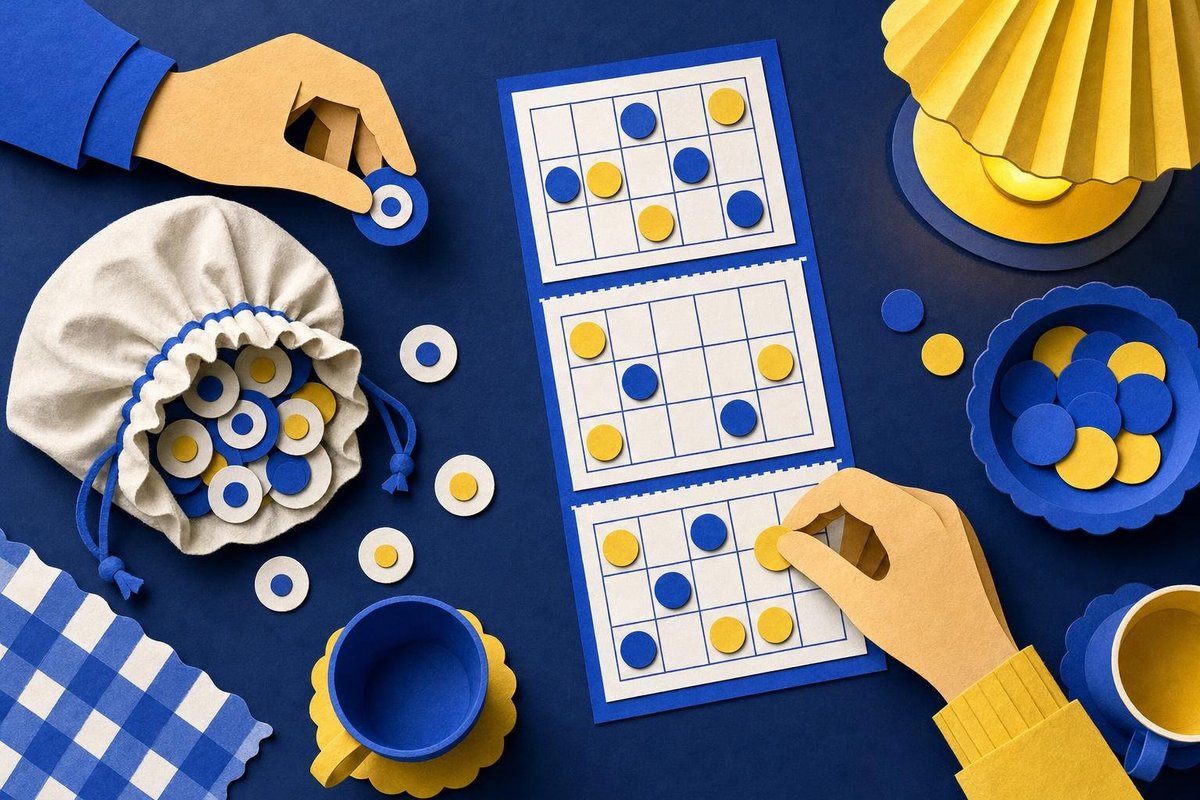
Bingo is one of the easiest games in the world to pick up. There is no strategy to learn, no cards to hold back and no opponent to read. What makes it feel tricky at first is the speed: a caller works through the numbers at a steady pace, and a beginner with three tickets in front of them can easily fall behind. This guide covers how to play bingo from the beginning, so the rules are second nature before the first number is called.
Bingo rules for beginners in five steps
These bingo rules for beginners apply to every format, from a seaside arcade to a phone screen. Here is how to play bingo step by step:
- Get a ticket. In a hall you buy a book of tickets for the session. Online, the game deals one for you. The free games on this site deal a new ticket every round.
- Listen for eyes down. The caller says it just before the first number. From now on the room is quiet.
- Mark each called number. If the number is on your ticket, dab it with a dabber, cross it with a pen or let auto-dab mark it on screen.
- Watch for the pattern. Each game has one or more wins: a line, two lines and a full house in 90-ball, a named pattern in 75-ball.
- Claim straight away. Shout "House!" or "Bingo!" the moment your pattern is complete. A checker reads your numbers back to the caller to confirm the win.
That is the whole game, and it is also how to play bingo at home with a set of tickets and a friend calling. Everything else is detail: which ticket a format uses, which patterns count and what the caller means by "legs eleven".
Bingo tickets and cards explained
The ticket is where beginners usually get stuck, because the two main formats use completely different layouts.
The 90-ball ticket
Used in British halls and most UK bingo games. A 90-ball ticket has three rows and nine columns, twenty-seven squares in all. Each row has five numbers and four blanks, so a ticket shows fifteen numbers. The columns run in bands of ten: 1 to 9 in the first column, 10 to 19 in the second, and so on up to 80 to 90 in the last. Six tickets printed together form a strip that holds every number from 1 to 90 exactly once. The 90-ball bingo page covers the ticket in full detail.
The 75-ball card
Used in North America and in many online rooms. A 75-ball card is a 5x5 grid with the letters B, I, N, G and O across the top. Each letter covers fifteen numbers, from B (1 to 15) to O (61 to 75). The centre square is free and counts as marked before the game starts. Calls come with the letter attached: "B 7", "N 42", "O 68".
The 80-ball and speed cards
80-ball uses a 4x4 card with sixteen numbers in four columns of twenty. Speed bingo uses a small 3x3 card with nine numbers from thirty. Both were designed for faster online play.
Winning patterns: how a bingo game is won
A game of bingo is won by completing a pattern, and the pattern depends on the format.
In 90-ball bingo
- One line. All five numbers on any one row.
- Two lines. Any two complete rows on the same ticket.
- Full house. All fifteen numbers on the ticket.
The three wins come in order within the same game. After the one-line winner is confirmed, play continues for two lines, then for the house.
In 75-ball bingo
The caller names a pattern before the game. Common ones include any straight line, the four corners, a letter X across both diagonals, a picture frame around the outer ring, a small postage stamp in one corner and the blackout, where every square must be marked. Some halls play special patterns such as a Christmas tree or a kite.
| Pattern | Format | Numbers needed |
|---|---|---|
| One line | 90-ball | 5 |
| Two lines | 90-ball | 10 |
| Full house | 90-ball | 15 |
| Straight line | 75-ball | 4 or 5 (with the free space) |
| Four corners | 75-ball | 4 |
| Letter X | 75-ball | 8 plus the free space |
| Picture frame | 75-ball | 16 |
| Blackout | 75-ball | 24 plus the free space |
How to play bingo step by step in a hall
Knowing how to play bingo step by step on paper makes a club night much easier.
A club night follows a familiar order, and knowing it takes most of the nerves out of a first visit.
- Arrive early. Buy your books at the desk and find a seat. Regulars have favourite spots, so ask if a seat is free.
- Check the programme. The session sheet lists every game, its format and its prizes. Each game usually has its own page in your book, often in a different colour.
- Set up. Lay out the right page for the first game, uncap your dabber and keep a spare pen.
- Eyes down. The caller announces each number once, often with its nickname, and shows it on the electronic board.
- Claim clearly. Shout as soon as you complete the pattern. Keep the ticket flat so the checker can read it.
- Between games. There is usually a break mid-session. Many halls also run quick interval games and a separate national game linked across clubs.
Talking during a game is frowned on in most halls, and so is claiming late. Neither is a rule a newcomer gets punished for, but both earn a look from the regulars.
Understanding the bingo caller
British callers have a vocabulary of their own. Many numbers come with a rhyme or a nickname: "legs eleven" for 11, "two little ducks" for 22, "two fat ladies" for 88, "top of the shop" for 90. The calls began in army huts and seaside halls, where a rhyme carried better than a bare number over the noise. Learning a dozen of them makes the game easier to follow and a lot more fun. The list of bingo calls and their meanings covers all ninety.
Other phrases worth knowing:
- Eyes down: the game is starting.
- On its own: a single-digit number, as in "on its own, number six".
- Checking: the game is paused while a claim is checked.
- We'll play on: the claim was wrong, so the game continues.
- Sweaty: needing just one number for the pattern.
How to play bingo online
The bingo rules for beginners above work online too, with less to do by hand.
Online bingo keeps the same rules and changes the handling. The game deals your tickets, draws the numbers, shows them on a board and marks them for you if auto-dab is on. It also sorts your tickets so the one closest to winning sits at the top, and it claims the win for you, so a slow shout never costs a prize.
The free bingo games on this site offer 90-ball, 75-ball, 80-ball and speed bingo with no account and no money. They are a simple way to practise reading a ticket before playing in a club or with friends.
Tips for beginners that actually help
- Scan by column. On a 90-ball ticket, a call of 63 can only be in the seventh column. On a 75-ball card, the letter tells you the column.
- Start with fewer tickets. One or two tickets are plenty for the first few games. Add more once you can keep up without stress.
- Learn the calls. The nicknames give you an extra half-second to find the number.
- Mark neatly. A clean dab in the middle of the square is easier for the checker to read than a smudge.
- Watch the board. If you think you missed a number, the board in the hall or the call list online shows every number drawn.
- Set a limit. In paid bingo, decide before you sit down how much the evening costs, and stick to it.
Bingo variations around the world
The game is played in different forms across the world. Tombola, the Italian family version, is played at Christmas with cards and a sack of numbered tokens. In Mexico, lotería uses picture cards such as el gallo and la sirena instead of numbers, with the caller reading out a riddle or verse for each. In Britain, the 90-ball game also lives on in seaside amusement arcades, where players sit at a counter with sliding shutters over each number.
Whichever version you meet, the rules boil down to the same three ideas covered in this guide: a random draw, a ticket and a pattern.
Playing bingo at home
A home game needs very little: a set of tickets, the numbers 1 to 90 on slips of paper or balls in a bag, and one person willing to call. Printed 90-ball tickets are easy to find, and a strip of six covers every number, so six players with one ticket each will always produce a winner. Use pens, counters or coins to mark numbers, and agree before the first call what counts as a win.
A few small touches make a home game feel like the real thing. Keep the called numbers in order on a board or a sheet of paper so claims can be checked. Have the caller use the traditional nicknames, at least for the famous ones. Play for something that is not money: the last slice of cake, first pick of the film, the right to call the next game. Children enjoy number bingo as a counting game, and older relatives often know more of the calls than anyone else at the table.
For a quick game with no setup, the free games on this site deal tickets and call the numbers on a screen. They are also a handy way to check the rules mid-argument.
Bingo etiquette in a club
Club bingo has a few unwritten rules that regulars notice. Keep quiet while numbers are being called, and save conversation for the gaps between games. Do not call out a number yourself, even if you think the caller missed one; tell a floor walker instead. Turn phones to silent. Claim clearly and only once. If you leave mid-session, do it between games. None of this is enforced with any severity, but following it makes a first visit much more relaxed.
Common beginner mistakes
- Playing the wrong page. In a hall book, each game has its own page. Check the colour against the programme.
- Waiting too long to claim. Once the next number is called, the claim may be invalid.
- Marking a number that sounds similar. 13 and 30, 14 and 40, 15 and 50 are easy to confuse. Callers often add the nickname to help.
- Assuming a pattern. In 75-ball, a line is not always the winning pattern. Listen to the announcement.
Questions and answers
What is the basic idea of bingo?
A caller draws numbers at random and announces them. Players mark those numbers on their tickets, and the first player to complete the pattern for that part of the game wins it.
What do I shout when I win at bingo?
In a British hall, shout "House!" or "Bingo!" loudly and straight away. If the caller announces the next number before you claim, the win may be lost.
What happens if two people win at the same time?
If two tickets complete the pattern on the same number, the prize is usually shared. Halls state their own rule for this at the start of the session.
How many numbers are on a bingo ticket?
A 90-ball ticket has fifteen numbers, five on each of three rows. A 75-ball card has twenty-four numbers plus a free centre square, and an 80-ball card has sixteen.
What is a full house in bingo?
Every number on the ticket marked. In 90-ball bingo it is the last and biggest win of each game. In 75-ball the same idea is called a blackout or coverall.
What is a bingo dabber?
A bottle of ink with a sponge tip used to mark paper tickets with a round blot. Dabbers come in many colours, and many regular players have a favourite.
What does eyes down mean?
It is the caller's signal that the game is about to start and the first number is coming. Everyone looks down at their tickets.
What is a bingo book or strip?
In 90-ball bingo, six tickets printed together as a strip. Between them they hold every number from 1 to 90 exactly once, so every call lands on one of the six tickets.
Is bingo a game of skill?
No. The draw is random and every ticket has the same chance. The only skill is keeping up with the calls and not missing a number, especially with several tickets.
How long does a game of bingo last?
A 90-ball game in a hall usually runs eight to twelve minutes. 75-ball games are a little shorter, and speed bingo can finish in under a minute.
Can you play bingo at home?
Yes. A set of tickets, ninety numbered balls or slips and someone to call is enough. The free games on this site work as a quick alternative in a browser.
What age do you have to be to play bingo in the UK?
Bingo for money in UK clubs and online is limited to adults aged 18 or over. Bingo played for fun, with no stake and no money prizes, has no such rule.
What does the caller mean by two little ducks?
It is the traditional call for 22, because the two 2s look like a pair of ducks. The full list of bingo calls explains the others.
Do I have to mark numbers myself in online bingo?
Most online games, including the free ones here, offer auto-dab, which marks numbers for you. Turn it off to play the traditional way.
Which bingo game is best for beginners?
90-ball bingo is the easiest to learn because it has three clear wins and no named patterns. Speed bingo is good for a first try because it is over so quickly.