Free scratch cards online: play for fun with no sign-up
A free online scratch card you can play as often as you like: six foil panels, one search for three matching symbols and no account, no download and no money.
Play a free scratch card online
Scratch all six panels
The free scratch card needs JavaScript to deal and reveal the symbols.
Free scratch cards are the quickest game on this site, and these free online scratch cards ask for nothing: no sign-up, no app, no money. There is nothing to learn and nothing to wait for: scratch the six panels, see what is underneath and deal another card. Because it is free, it is also the easiest way to see how a scratchcard really works, from the moment the symbols are fixed to the moment the last panel is cleared.
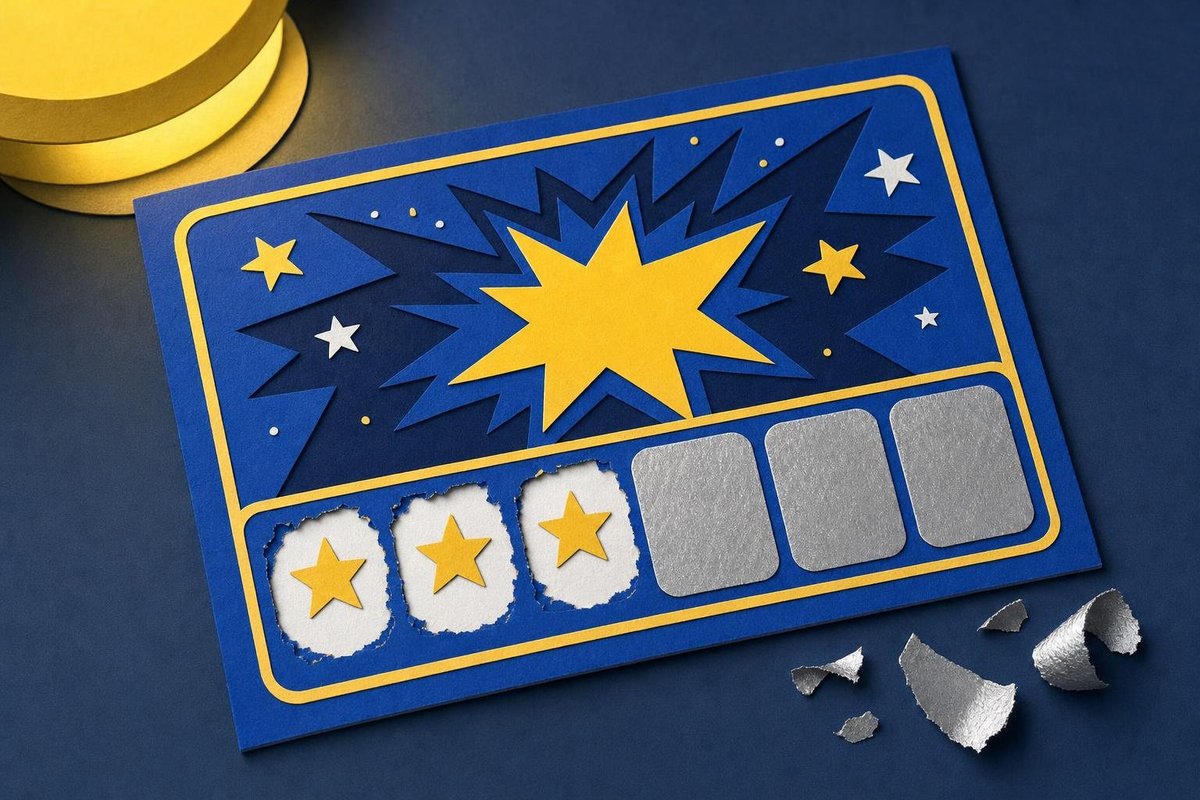
Each card shows six panels in two rows. Under the foil are symbols taken from a small set: a star, a bell, a four-leaf clover, a horseshoe, a seven and a crown. Three of the same symbol make a winning card. Press New card to deal again; there is no limit and no waiting time between cards.
The card is dealt in full the moment it appears. Scratching only uncovers it, the same way a printed ticket is finished at the factory long before anyone buys it. That single fact explains most of what follows on this page, including why there is no technique that changes the result.
How online scratch cards work
A paper scratchcard and a free online scratch card share the same principle: a result that already exists, hidden under a cover. On paper, the cover is a latex coating printed over the game area. On screen, it is a layer that disappears when you tap. In both cases the panels are a reveal, and the result was decided earlier.
The game area
Most cards have one or more game areas, each with its own rule. The classic version is the one on this page: match three symbols. Others ask you to beat a number printed on the card, reveal a word in a crossword grid or find a symbol that unlocks a prize box. However the game is dressed, the outcome is printed under the coating from the start.
The coating
The scratch-off layer is not a single coat of paint. Printers lay down a white base, the symbols, a release layer that lets the latex come away cleanly, an opaque blocking layer and finally the silver or coloured latex on top. The blocking layer is what stops someone holding a card up to a light and reading it through the foil.
Validation
Every paper ticket also carries a barcode and a validation code, usually under a small panel of its own. The shop terminal reads the code to check whether a ticket has won and whether it has already been paid. Without it, a winning ticket could be presented twice.
Free scratch cards to play for fun with no sign-up
Scratchcards are popular because they are fast and simple, and the same qualities make free scratch cards a pleasant thing to tap through when nothing is at stake. A few rounds show how the rhythm of a card works: the hopeful first match, the second panel that confirms or ruins it, the last panel that settles it. Playing free online scratch cards also takes away the two things that make paper tickets a habit worth watching: the cost and the urge to buy just one more.
- Any order works. The result is fixed, so scratching left to right, right to left or at random changes nothing.
- No near misses that mean anything. Two matching symbols are not a sign that a third is close. Each card is independent.
- No streaks. A run of losing cards does not make the next one more likely to win.
Scratchcard odds explained
Every UK National Lottery scratchcard prints its overall odds on the back. A typical card says something like "overall odds of winning any prize: 1 in 3.8". That figure covers every prize on the card, and most of those prizes are equal to the price of the ticket or only a little more.
| Term on the card | What it means |
|---|---|
| Overall odds | The chance a ticket wins any prize at all, including a prize equal to its own price. |
| Top prize odds | The chance of the largest prize. On high-priced cards this can be one in several million. |
| Prizes remaining | Published online by lottery operators so players can see whether top prizes on a game are still unclaimed. |
| Game closure | The date after which a game stops being sold and, later, the last date a prize can be claimed. |
Free scratch cards with no sign-up are a good place to see these odds play out. To play for fun, deal a few dozen cards: on the free card here, about one card in three shows three of a kind. It is set to feel similar to a paper card without pretending to model any particular game.
Types of scratch cards
Three of a kind is the oldest rule, but printed cards come in many styles. Knowing them makes it easier to read any card at a glance:
- Match three. Scratch the whole area and look for three identical symbols or amounts. The free card on this page uses this rule.
- Beat the number. A "your numbers" area is compared with a "winning numbers" area; any match wins the prize shown underneath.
- Crossword. Letters are revealed one at a time and filled into a printed grid. Complete words win, and more words win more.
- Bingo scratchcards. A caller's list of numbers is scratched and matched against one or more printed bingo cards. Lines, corners and a full card each pay differently.
- Multiplier cards. A symbol in a bonus box multiplies whatever the rest of the card shows.
Whatever the style, every type has the same basic structure: a game area, a set of rules printed next to it and a result that is fixed before the card is sold.
Bingo on a scratchcard
The bingo scratchcard deserves a word of its own on a bingo site. It packs a whole bingo game into a single card: a column of called numbers under the foil on one side, three or four small bingo grids on the other. Scratch the calls one at a time and mark the matching numbers on the grids, exactly as a player in a hall would mark a ticket. The patterns are printed beside each grid, typically a line, an X and a full card.
It is a neat way to see the two games side by side. In real bingo the draw is shared by everyone in the room and happens live. On a bingo scratchcard, the draw happened at the printer, so the order of the calls and the result were set before the card left the factory. The free bingo games on this site have a live draw; the scratch card above does not, and that is the whole difference between the two kinds of game.
Reading a scratch card before playing
Every paper card carries more information than its colourful front suggests. Turning it over before scratching takes ten seconds and answers most of the questions people later ask:
- How to play. The rule for each game area, sometimes with a worked example.
- Prize table. Every prize the card can pay and, on many cards, how many of each exist across the whole print run.
- Overall odds. The chance of any prize, including those that only return the price of the ticket.
- Game number and closing date. Useful for checking online whether top prizes are still unclaimed.
- Age limit. In Great Britain, National Lottery scratchcards may only be sold to people aged 18 or over.
None of that applies to the free scratch card here, which has one rule, no prizes and no age limit beyond common sense. It is still a useful habit for anyone who also buys paper cards.
Why scratch cards feel the way they do
Scratch cards are designed around a short burst of suspense. The first panels show a symbol, the next ones raise hope with a second match, and the last ones settle it. Many cards also show near misses: two top-prize symbols and a third that is something else. Researchers who study instant games point out that a near miss feels like getting close, even though on a pre-printed card it means nothing about the next one.
Seeing that rhythm on free online scratch cards, with nothing to gain or lose, is a good way to notice it. Deal ten cards in a row and the pattern becomes familiar: most cards show a pair somewhere, few show three, and none of the pairs say anything about what comes next.
A short history of the scratchcard
Instant games existed before the scratch-off coating; early versions used pull-tabs and sealed envelopes. The modern card came out of the United States in the early 1970s, when John Koza and Daniel Bower of the company Scientific Games worked out how to print instant tickets with secure, computer-generated results. In 1974 the Massachusetts state lottery sold the first scratch tickets of that kind, and other states followed within a few years.
Britain got them with the National Lottery. The first draw took place in November 1994, and in March 1995 the first scratchcards, sold under the name Instants, went on sale in newsagents. They became one of the lottery's biggest products, and today they come in dozens of designs at prices from one pound upwards.
Online scratch cards followed in the 2000s, first as simple flash games and later as animated versions on phones. The free scratch cards with no sign-up on this page take the oldest and simplest rule, three of a kind, and leave out everything else.
Free online scratch cards on a phone
Scratch cards suit a phone screen perfectly: six panels, a tap each and a result in seconds. The free card here works in portrait or landscape, needs no app and uses no data after the page has loaded. Panels reveal with a quick wipe, or instantly for anyone whose device is set to reduce motion. Because nothing is stored, a new card is always one tap away and no history builds up.
Scratch cards and bingo
Scratchcards and bingo grew up side by side in British clubs and later on the same websites, and many players enjoy both. They are different kinds of game, though. Bingo has a draw that everyone in the room shares and a ticket that slowly fills up. A scratchcard is private and over in seconds. Between rounds of the free bingo games, a scratch card is a natural pause, and both are there to play for fun.
For anyone who finds that paper scratchcards or any other paid game have stopped being fun, free, confidential help is available from GamCare and the National Gambling Helpline on 0808 8020 133.
Questions and answers
Are these scratch cards free?
Yes. Every card on this page is a free practice card. Nothing is bought, nothing is staked and the symbols win nothing but a message on screen.
Do I need to sign up to play free scratch cards?
No. There is no account, no email address and no app. Open the page and scratch.
How do I win on a free scratch card?
Scratch all six panels. If three of them show the same symbol, the card is a winner. Two pairs or six different symbols mean no win.
How often does a card win here?
Roughly one card in three shows three of a kind. That is close to the overall odds printed on many paper scratchcards, although most of those wins are small prizes on real tickets.
Is the result decided when I scratch?
No. The six symbols are dealt the moment a new card appears, just as a printed card is finished before it reaches the shop. Scratching only reveals what is already there.
Can I play free scratch cards online on a phone?
Yes. Tap each panel to scratch it. The card works on phones, tablets and computers in any modern browser.
What are the odds on a real UK scratchcard?
National Lottery scratchcards print their overall odds on the back, commonly between about 1 in 3 and 1 in 5 for any prize. The odds of the top prize are far longer, often in the millions.
Why are scratchcards called instant games?
Because the result is known the moment the panels are scratched, with no draw to wait for. In the lottery world they are also called instant win tickets.
Who invented the scratchcard?
The computer-generated instant ticket was developed in the United States in the early 1970s by John Koza and Daniel Bower of Scientific Games. Massachusetts sold the first state lottery scratch tickets in 1974.
When did scratchcards arrive in the UK?
The National Lottery launched its first scratchcards, called Instants, in March 1995, a few months after the first lottery draw.
How is the coating on a scratchcard made?
The latex coating is printed over the game area in several layers, with a light-blocking layer underneath so the symbols cannot be read by holding the card up to a light.
What does the barcode on a scratchcard do?
It identifies the ticket so a retailer's terminal can check whether it is a winner. The validation code under its own small panel stops anyone checking a card without scratching it.
Are online scratch cards the same as paper ones?
The idea is the same: a result fixed in advance and revealed by scratching. Online versions add animation and sound; the free card here keeps to six panels and three of a kind.
Is there a trick to scratch cards?
No. Every card is decided before it is scratched, and the order you scratch the panels in makes no difference to the result.
Do the free scratch cards need JavaScript?
Yes, to deal and reveal the symbols. Without it, the rest of this page reads normally.